OUR LINEAGE Takeda, Sokaku Choi, Yong Sul
Rim, Jong Bae
Joe Sheya
Paul Hummer
Will Willis
History



Takeda, Sokaku- Daitō-Ryū aiki-jūjutsu (大東流 合気柔術) is one of the oldest and most proven systems of jūjutsu. It is the style of jujutsu from which Aikido and Hapkido were derived in the mid-20th century. It is believed that Daitō-Ryū had its earliest origins in the art of tegoi, a grappling system that also gave rise to the sport of sumo. Written accounts of tegoi date back to the Kojiki, written in 712 AD. It is known that the personal bodyguards to the emperors and shogun of Japan have been trained in Daito-Ryu for over 1,000 years as the primary method of defending against both armed and unarmed attackers. The samurai were officially abolished in 1868 and subsequently stripped of their right to wear katana in public. In 1871 all Japanese daimyō were ordered to vacate their castles, making a system of budō designed to defend castle occupants against armed samurai and ninja no longer necessary. Without bodyguards and retainers to teach and train, Takeda Sōkichi and his son, Takeda Sōkaku,(1859—1943) began teaching Daitō-Ryū to members of the public in the late 19th century, and the art was released from the bonds of secrecy. Takeda Sōkaku kept meticulous records of his instruction and is known to have taught thousands of students during his lifetime. Among them were Ueshiba Morihei (1883—1969), the founder of Aikidō, Choi Yong-Sul (1904—1986), the founder of Korean Hapkido, and Okuyama Yoshiji Ryuho (1901— 1987), the founder of Hakkō-Ryū.
Choi, Yong Sul- Hapkido (합기도), meaning the Way of Harmony, is the martial art of Choi, Yong Sul (1904-1986). Mr. Choi was born in Korea, but was brought to Japan as a young boy. Eventually he was taken into the household of Takeda Sokaku, head of Daito-Ryu Aiki-jujutsu. Mr. Choi lived and studied with Takeda Sokaku until Sokaku’s death. At the end of World War II, Mr. Choi returned to his native Korea and supported himself and his family by teaching Hapkido, which was based on the Daito-Ryu Aiki-jujutsu he had learned in Japan. Mr. Choi died in 1986.
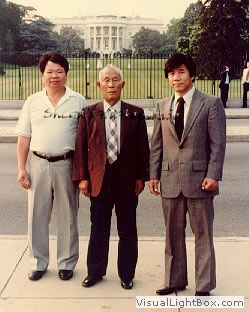
Rim, Jong Bae- Mr. Rim immigrated to the United States in 1973 and settled in Baltimore, Maryland. Mr. Rim, a Master promoted personally by Hapkido's founder, Grandmaster Choi, Yong Sul, participated in a couple of martial arts demonstrations soon after he arrived. A spectator at one of these demonstrations told Joe Sheya that Hapkido might be what he was looking for. Joe visited Mr. Rim to inquire about Hapkido. Communication was difficult, so this first meeting consisted of Mr. Rim demonstrating Hapkido on Joe. A lasting relationship developed from this unlikely beginning. For a while Joe was the only student, but gradually others joined the group. After Joe was promoted to black belt, he started teaching on his own and attracting more students. Mr. Rim had several black belt students at the time of Mr. Choi's visit in 1982. After the meeting in New York, Mr. Choi visited Mr. Rim in Maryland and worked out in the Dojang with Joe and his students. Mr. Choi was pleased to see his traditional method of instruction preserved and he posed with the school for a photograph.
Joe Sheya- Joe Sheya was born in San Franciso in 1949. His family lived in several different parts of the country as he grew up. He did some boxing as a kid, and he was involved in a few street fights later on, but he had no contact with the martial arts until college. In the early 70's Joe attended the University of Maryland at College Park, where he received a degree in education. Joe is a former Anne Arundel County public school teacher. In college Joe started taking Tae Kwon Do, the average person's perception of what martial arts was. It was fun for a couple of months, but once the newness wore off he realized it wasn't much different than his fighting as a teenager. Tae Kwon Do amounted to using force to damage your attacker. He wanted something else. A stranger gave Joe Mr. Rim’s address and said Hapkido might be what he was looking for. Mr. Rim demonstrated Hapkido to Joe by throwing him around his living room. Joe left realizing that even though he had been completely man-handled, his attacks had been handled but he was not hurt. To Mr. Rim's surprise he returned the next day, and the day after that. After about three weeks, Mr. Rim told Joe he was coming too often and handed him a calendar. They worked out a schedule and began regular lessons. Initially the lessons were fairly rough. If Joe had been less robust he wouldn't have been able to continue. Eventually Mr. Rim started teaching Joe differently, showing him the details behind the basic motions. Joe invested in video taping equipment and started taping all of their sessions. In 1982, Mr. Rim and Joe took a train to New York City to attend an international meeting with Mr. Choi. They met at the Korean restaurant, Yong Bin Kwon. It was important to Joe to meet Mr. Choi. At this Meeting, Mr. Rim declared Joe his brother and his inheritor. Later, Mr. Choi declared Joe "Kwang Jang" and Master Instructor for the United States. Joe dedicated himself to teaching Hapkido in the traditional manner he was taught, forming “Sheya’s Traditional Hapkido Association.” Sheya was steadfast in his commitment until he passed in 2014.
Paul Hummer- A golf fanatic with a 6 handicap, Paul finds that the martial arts helps so much in areas like focus, tension, stress, etc. Paul has been practicing Martial Arts for over 40 years. He began by studying Tang Soo Do in the early eighties, but he has evolved quite a bit from that style. Paul is the Grandmaster of a style of Korean Karate called Takido and was one of the founders of Martial Arts United, until it closed in 2017. Takido (多岐道), meaning The Way of Many Branches, is a combination of sparring, kata, and soft style motions. Paul met Joe Sheya many years ago at a martial arts tournament. He studied with Master Sheya from 1992 until Sheya’s passing in 2014. Not only is Paul a Grandmaster of Korean Karate, but he is also a 5th Dan Master in Traditional Hapkido. Now 82 years old, Paul has mostly retired from teaching Karate but visits from time to time.
Will Willis- Will began taking Karate lessons from Mr. Paul Hummer in 1998 on Kent Island, Maryland at 13 years old, and has continued to practice to this day, 28 years later. After receiving his Black Belt in Korean Karate, Will would stay after class to observe the other styles of Martial Arts practiced at the school and became interested in Traditional Hapkido. Will decided to study Traditional Hapkido with Mr. Paul, while also continuing to study Karate, advancing up the ranks. On occasion, Will went with Mr. Paul to visit Mr. Joe Sheya and learn from other Masters in Hapkido as well. Mr. Joe would also visit our Dojang, giving the students pointers on how to improve their motions. Shortly after Mr. Joe passed, Will earned his second Black Belt in Traditional Hapkido. In 2017, Will faced a pivotal moment when Martial Arts United closed down and the other Masters of Takido decided to retire, leaving Will as the only one desiring to continue teaching our style of Karate to future generations. With Mr. Paul’s permission, Will partnered with Brandon Taylor and founded Street Smart Martial Arts LLC; changing the style’s name from Takido to Noble Way (고귀한길), incorporating more Hapkido motion into the curriculum. This endeavor was born out of resilience and a deep commitment to their craft. However, their aspirations were temporarily halted by unforeseen challenges, leading Taylor to step out of the business. Then Covid-19 happened, creating another setback. But despite these setbacks Will remained steadfast in his vision. In 2026, with renewed determination, Will reopened Street Smart Martial Arts LLC, demonstrating his unwavering dedication to his students and the martial arts community.